Collaborators

Dr Blandine French
University of Nottingham

Dr Sarah Cassidy
University of Nottingham

Kristy Angell
University of Nottingham

Dr Martin Knapp
London School of Economics

Rose Matthews
Advisory group.
Since discovering that I am Autistic in 2018 I’ve been involved in Autism advocacy, activism, and research work

Mat Rawsthorne
Advisory group
I am an experienced Mental Health Service User and Researcher

Adam Brown
Advisory group
Late diagnosed with AuDHD. Still learning about me, trying to help others and raise awareness.
Autistica
National Autistic charity
Summary
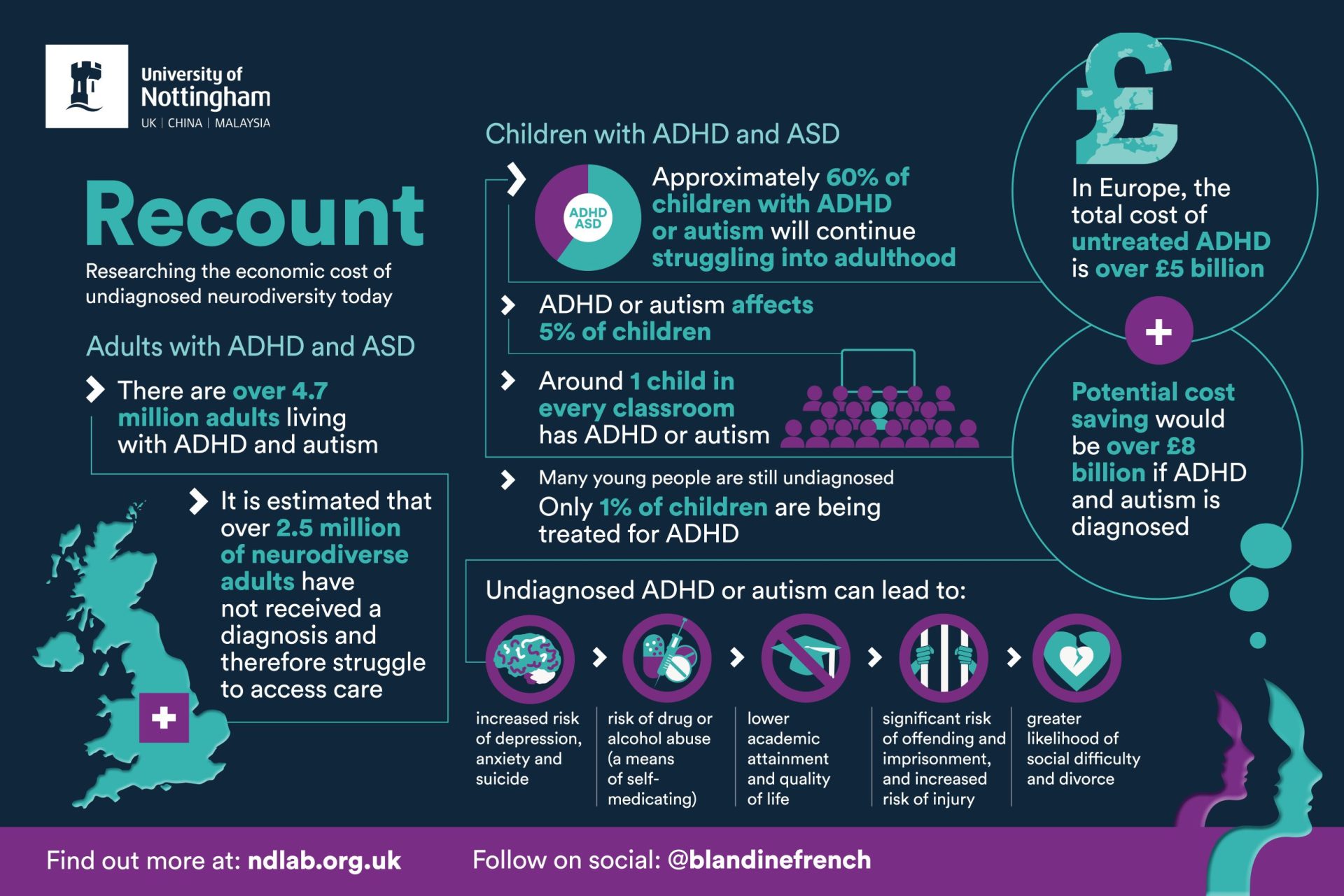
In the UK, there are over 2.5 million undiagnosed neurodivergent adults, who struggle to receive support. Attention deficit hyperactivity disorder (ADHD) and autism are the most common forms of neurodivergence. In the UK around 1 in every 20 children, and 3 in every 100 adults have ADHD and/or autism. Although there has been more understanding and awareness about autism and ADHD in recent years, many adults and children still don’t have a diagnosis. Without a diagnosis, it is impossible to access the care that they need.
Adults with undiagnosed ADHD or autism face many difficulties. For example, they are more likely to drop out of school, experience depression and anxiety, be involved in crimes, and have problems with drugs or alcohol. Early identification and effective support can reduce these difficulties. It is crucial to diagnose ADHD and autism as early as possible to reduce these long-term risks for adults with these conditions.
Currently, there is no research on the risks of not receiving an ADHD or autism diagnosis. However, this three-year project looked at the impacts of undiagnosed ADHD or autism on individuals and their families. It also assessed the economic and societal costs of undiagnosed ADHD and autism. This research will provide essential information to decision makers and healthcare providers, enabling them to improve access to care.
We had two main questions:
- What are the long-term risks of not diagnosing individuals with ADHD or autism?
- How much does the lack of diagnosis cost individuals, the community, and the economy?
We wanted to:
- Understand the risks and costs of not diagnosing ADHD or autism.
- Highlight the importance of early diagnosis for ADHD and autism.
What we have done
Methods
To answer the questions of what are the long term risks associated with undiagnosed ADHD/ASD and what are the costs of these risks, the project included two phases:
Phase 1
The first phase identified the risks associated with having undiagnosed ASD/ADHD, from a systematic review of the available evidence (Paper 1). Semi structured interviews were conducted with undiagnosed/late diagnosed adults with ASD/ADHD and their families. Interviews were also conducted with healthcare professionals to highlight the risks associated with late diagnosis (Paper 2).
Phase 2
The second phase concentrated on establishing the economic costs of the identified risks associated with undiagnosed ASD/ADHD. Through an economic evaluation, the risks associated were compared between two adult groups: diagnosed and undiagnosed.
Co-production
A steering group informed the project throughout its entire research cycle. A group of 10 adults with a late diagnosis of ADHD/ASD agreed to feedback on different stages of the project to ensure we were capturing the experiences truly. The group helped the research team interpret findings from the systematic review, identify risks not explored in previous research and those risks which require further investigation in the qualitative study. They assisted in drafting an interview schedule prior to semi-structured interviews with late diagnosed adults affected by ADHD and/or autism and their families to identify the full range of potential risks associated with being undiagnosed with these conditions. And finally the group assisted with the economic evaluation questionnaire.
What did we find?
Phase 1
The systematic review showed that adults with undiagnosed ADHD/ASD were more likely to have:
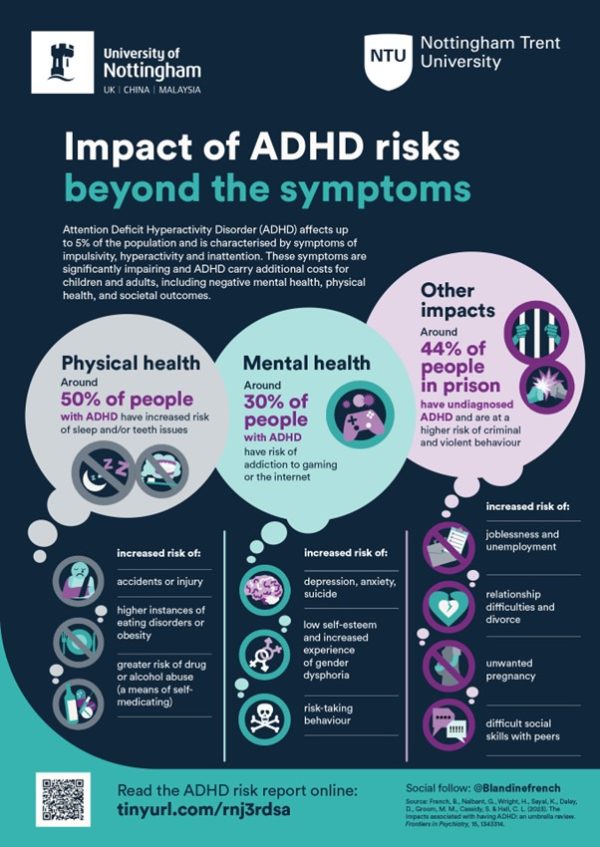
The risks associated with having ADHD umbrella review:
Our comprehensive review shed light on the extensive ramifications of having ADHD, revealing mental health vulnerabilities, physical health risks, and societal implications, emphasizing the necessity of a holistic approach.
“Going Through Life on Hard Mode”—The Experience of Late Diagnosis of Autism and/or ADHD: A Qualitative Study
This qualitative study reflected on the experiences and impact of receiving a late diagnosis of ADHD or autism.
Five key themes were constructed from the analysis:
These findings reinforced the benefits that can come with early diagnosis, through understanding, finding a community, and better mental health. The study also highlighted the potential drawbacks of this and can help adults, as well as health care professionals, understand the process of diagnosis and its potential impact (negative or positive).
Phase 2
After establishing the risks associated with undiagnosed Autism/ADHD, the second phase focused on an economic evaluation to assess the individual and societal economic costs associated with these risks.
A survey was conducted with 839 adults with ADHD or autism living in England. We compared two groups: adults with undiagnosed ASD/ADHD and adults diagnosed with ASD/ADHD. The survey enabled the collection of data regarding outcomes, service use, diagnosis and participant demographic characteristics.
Findings
Many adults in the UK who have ADHD and/or autism are not formally diagnosed, which can limit their access to support and make it difficult to understand the true personal and societal costs of these conditions. This study surveyed 839 adults across the UK to compare costs and experiences between those who had a clinical diagnosis of ADHD or autism and those who showed clear signs of these conditions on recognised screening tools but had not been diagnosed. The findings showed that adults with a diagnosis had higher costs overall, including greater use of health and mental health services and higher receipt of disability-related benefits. This likely reflects the fact that diagnosis helps people access support they need. In contrast, undiagnosed adults had lower recorded costs but similar levels of anxiety and depression, suggesting that their needs may be going unmet and their difficulties are less visible within current systems. Overall, the study highlighted the importance of earlier identification, faster diagnostic pathways, and better support after diagnosis to reduce hidden harm and improve outcomes for adults with ADHD and autism.
We put together two videos to describe the findings from the RECOUNT study. The first video is 6 minutes long and the second video is a shorter 2 minute summary.
Here is a 6 minute video describing the findings from the RECOUNT study:
Here is a 2 minute summary video describing the findings from the RECOUNT study:
Publications
Publications related to this project
Infographic: Risks associated with undiagnosed ASD/ADHD
Infographic: Impact of ADHD risks beyond the symptoms
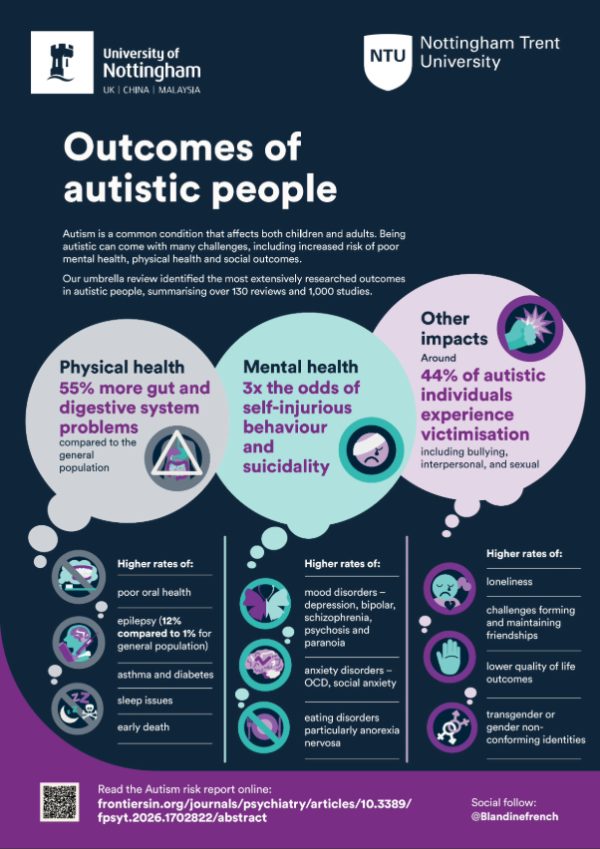
Infographic: Outcomes of autistic people